Reverse Osmosis Water Treatment Technology in Industrial and Municipal Applications
Reverse Osmosis Water Treatment Technology in Industrial and Municipal Applications
Reverse Osmosis has become one of the most widely used water purification technologies across industrial, municipal, and commercial sectors. The technology is capable of removing dissolved salts, organic contaminants, bacteria, and heavy metals from water, producing high-quality purified water suitable for various applications.
The process of reverse osmosis is based on the principle of osmotic pressure. In natural osmosis, water moves from a region of low solute concentration to a region of high solute concentration through a semi-permeable membrane. Reverse osmosis reverses this process by applying pressure to force water molecules through the membrane while retaining dissolved impurities.
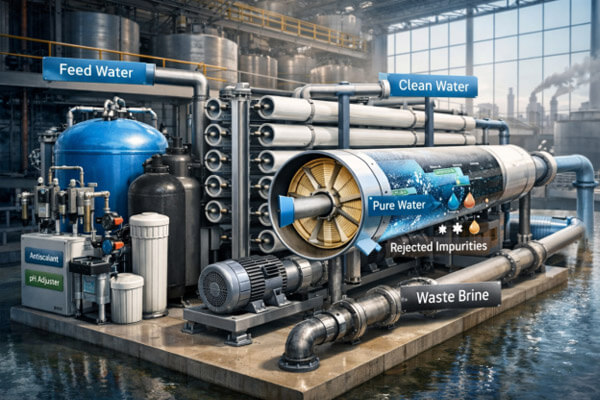
An industrial reverse osmosis plant typically consists of several major components. The feed pump is responsible for supplying raw water to the treatment system. Before entering the RO membranes, the water must undergo pre-treatment to remove suspended particles, chlorine, and organic matter that could damage the membranes.
Pre-treatment systems generally include multimedia sand filters, activated carbon filters, and cartridge filters. Chemical dosing systems are also used to add antiscalants and pH adjustment chemicals to protect the membranes from scaling and fouling.
After pre-treatment, a high-pressure pump increases the water pressure to overcome the osmotic pressure of dissolved salts. This pressure drives water molecules through the RO membranes.
The membranes themselves are typically made of thin-film composite polyamide material, which allows water molecules to pass while rejecting dissolved salts, bacteria, viruses, and organic contaminants.
Pressure vessels house multiple membrane elements connected in series to achieve the desired water recovery and purification efficiency.
Industrial RO plants are widely used in applications such as boiler feed water preparation, pharmaceutical water production, food and beverage processing, semiconductor manufacturing, and desalination of seawater.
Modern RO systems can remove up to 99 percent of total dissolved solids, making them one of the most effective water purification technologies available today.
In addition to producing high-quality water, reverse osmosis systems also contribute to sustainable water management by enabling industries to recycle treated wastewater and reduce freshwater consumption.
Portico Environmental Services provides comprehensive solutions for reverse osmosis plant design, installation, commissioning, and long-term operation and maintenance. Liquid Discharge systems, helping industries achieve environmental compliance and water sustainability.
Help and Support
response@portico-enviro.com