Sewage Treatment Plants (STP) for Residential, Commercial and Industrial Applications
Sewage Treatment Plants (STP) for Residential, Commercial and Industrial Applications
Rapid urbanization and increasing water consumption have significantly increased the volume of sewage generated in residential, commercial, and industrial facilities. Untreated sewage contains organic pollutants, suspended solids, pathogens, and nutrients that can contaminate natural water bodies and pose serious environmental and public health risks.
Sewage Treatment Plants (STPs) are designed to treat domestic wastewater and remove contaminants before the treated water is discharged or reused. Modern STP systems utilize a combination of biological treatment, filtration, and disinfection technologies to achieve high treatment efficiency.
At Portico Environmental Services, sewage treatment plants are engineered based on detailed analysis of wastewater characteristics, hydraulic load, and site constraints. Each system is designed to ensure compliance with regulatory discharge standards while maximizing water recovery and operational efficiency.
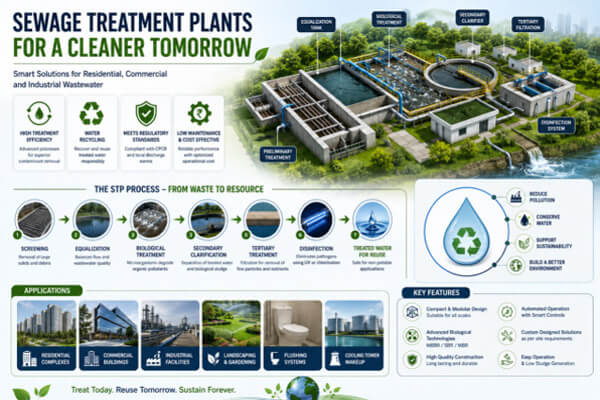
A typical sewage treatment plant begins with preliminary treatment, where large debris and floating materials are removed through screening systems. Equalization tanks are used to balance fluctuations in wastewater flow and composition, ensuring stable treatment performance.
The biological treatment stage is the core of the STP process. Technologies such as Moving Bed Biofilm Reactor (MBBR), Sequencing Batch Reactor (SBR), and Membrane Bioreactor (MBR) are commonly used to degrade organic pollutants. Microorganisms metabolize organic matter and convert it into stable biomass, carbon dioxide, and water.
Following biological treatment, secondary clarification separates treated water from biological sludge. The clarified water then undergoes tertiary treatment through sand filtration, activated carbon filtration, and disinfection systems such as UV treatment or chlorination.
Treated sewage water can be safely reused for applications such as landscaping, cooling tower makeup water, flushing systems, and construction activities.
Portico Environmental Services provides end-to-end STP solutions including design, engineering, installation, commissioning, and operation & maintenance services, ensuring long-term performance and environmental compliance.
Help and Support
response@portico-enviro.com