Zero Liquid Discharge (ZLD) Systems for Sustainable Industrial Wastewater Management
Zero Liquid Discharge (ZLD) Systems for Sustainable Industrial Wastewater Management
Industrial growth and increasing water scarcity have forced industries to rethink their wastewater management strategies. One of the most advanced solutions adopted globally is the implementation of Zero Liquid Discharge (ZLD) systems.
Zero Liquid Discharge refers to a treatment process where all wastewater generated from industrial operations is treated and reused, leaving no liquid effluent discharged into the environment. The objective of ZLD systems is to maximize water recovery and convert dissolved contaminants into solid residues.
Zero Liquid Discharge refers to a treatment process where all wastewater generated from industrial operations is treated and reused, leaving no liquid effluent discharged into the environment. The objective of ZLD systems is to maximize water recovery and convert dissolved contaminants into solid residues.
Industries such as textile processing, pharmaceuticals, chemicals, power generation, and petrochemicals generate wastewater containing dissolved salts, heavy metals, and hazardous chemicals. Conventional treatment plants cannot always meet the strict environmental discharge standards imposed by regulatory authorities. ZLD systems address this challenge by integrating multiple treatment technologies.
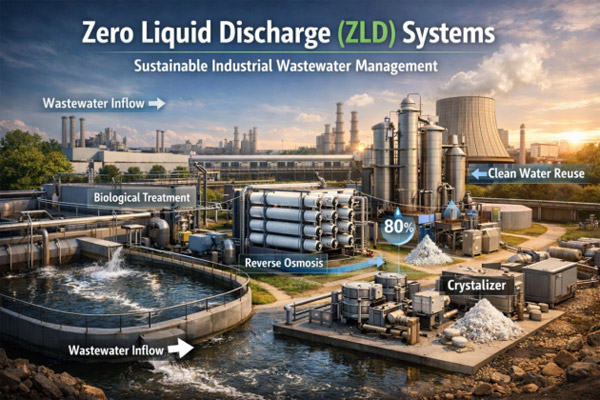
A typical ZLD process begins with primary treatment where suspended solids, oil, and grease are removed through coagulation, flocculation, and clarification. Equalization tanks are used to balance the wastewater flow and maintain consistent water quality entering downstream processes.
The wastewater is then treated using biological treatment systems such as activated sludge processes, Moving Bed Biofilm Reactors (MBBR), or Membrane Bioreactors (MBR). These processes reduce organic pollutants such as Biochemical Oxygen Demand (BOD) and Chemical Oxygen Demand (COD).
Following biological treatment, advanced membrane technologies such as ultrafiltration and reverse osmosis are used to separate dissolved solids from water. Reverse osmosis systems recover a significant portion of treated water, typically between 70–80 percent.
The reject stream from the RO system contains high concentrations of dissolved salts. This stream is further processed through thermal evaporation systems such as Multiple Effect Evaporators (MEE) or Mechanical Vapor Recompression (MVR) evaporators.
Finally, the concentrated brine is processed in crystallizers where dissolved salts are converted into solid crystals that can be safely disposed of or sometimes reused in industrial processes.
ZLD systems allow industries to recover up to 95 percent of wastewater for reuse in cooling towers, process water, and other applications. This significantly reduces freshwater consumption while ensuring compliance with environmental regulations.
With increasing regulatory pressure from pollution control boards and rising water costs, ZLD technology is becoming an essential component of sustainable industrial water management.
Portico Environmental Services provides complete solutions for designing, installing, and operating Zero Liquid Discharge systems, helping industries achieve environmental compliance and water sustainability.
Help and Support
response@portico-enviro.com